
How the Marshall Court Calendar Works
The Indiana Hearing Calendar searches by county, optional court, and date. It can also use a date with a cause number or short case-name string. Results may show court, cause number, public case style, hearing description, session date, timeslot, location, judicial officer, phone, and a MyCase link.
The date picker uses a rolling window of the prior seven days and next four weeks. A date outside that range may still be valid. Read the Chronological Case Summary, or CCS, and the latest filed notice for older or more distant settings.
Marshall Calendar Coverage Gaps
The live county selector returned only Marshall Superior Court 1 and Superior Court 2. Circuit Court and Superior Court 3 remain active, but were not public-calendar choices when researched. The calendar is therefore not a countywide list of every hearing.
No row does not mean no setting. Circuit carries broad civil, family, probate, juvenile, and guardianship work. Superior 3 carries assigned criminal, civil collection, and mental-health cases. Use MyCase, the notice, the clerk, or the court office for those dates. The state court directory confirms all four active courts.
The calendar interface image comes from the official Indiana Hearing Calendar.
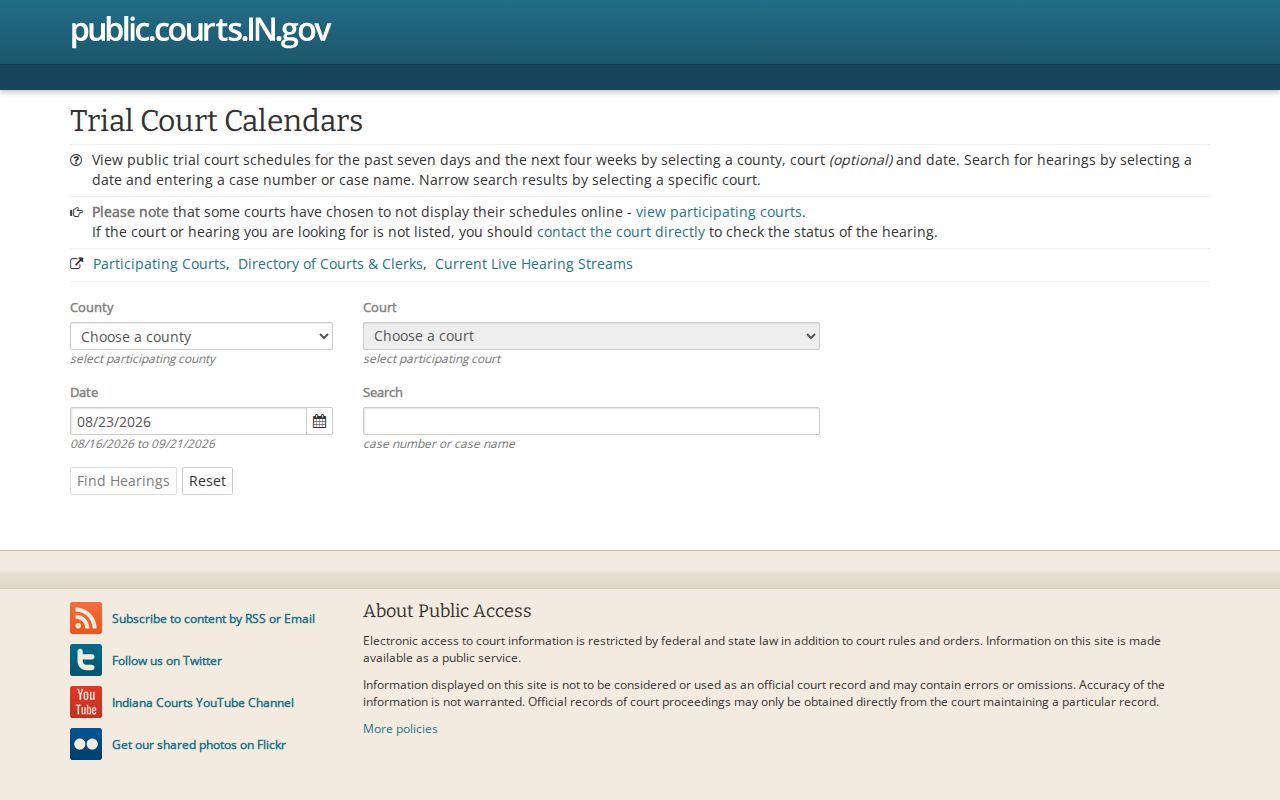
Its county, court, date, and search controls show both the tool's value and why the participating-court limit must be checked.
Marshall County Court Date Lookups
Use the court and cause number printed on the notice. Online, choose Marshall, select Superior Court 1 or 2 when known, pick the date, and select Find Hearings. A case number can narrow the selected day. For dates outside the range, search Indiana MyCase and read the latest CCS event.
- Open the Hearing Calendar and choose Marshall.
- Select the participating court and date.
- Match the cause number and hearing description.
- Cross-check the CCS and filed notice.
- Call the setting court when details conflict.
Other channels matter. The clerk's counter or phone can identify the record. A courthouse posting can show the day's call, but should not replace the filed notice. A represented party should check with counsel. Contact the setting court, not PayGov or Doxpop, for a schedule issue.
Marshall Court Phone Shortcuts
Superior Court 2's phone tree at 574-935-8763 routes today's hearing, a missed hearing, or a pending warrant to option 2. Option 3 addresses fines and costs, option 4 other criminal matters, and option 5 civil and small claims. The county page duplicates some numbers for juror and interpreter choices, so listen to the current menu.
Superior Court 1 is 574-935-8740. Circuit's administrator is 574-935-8780, reporter 574-935-8786, and bailiff 574-935-8796. Superior Court 3 lists reporter 574-936-8259 and bailiff 574-936-3198. Direct a date question to the court code on the cause number.
The local contact image is sourced from the official Marshall Superior Court No. 2 page.
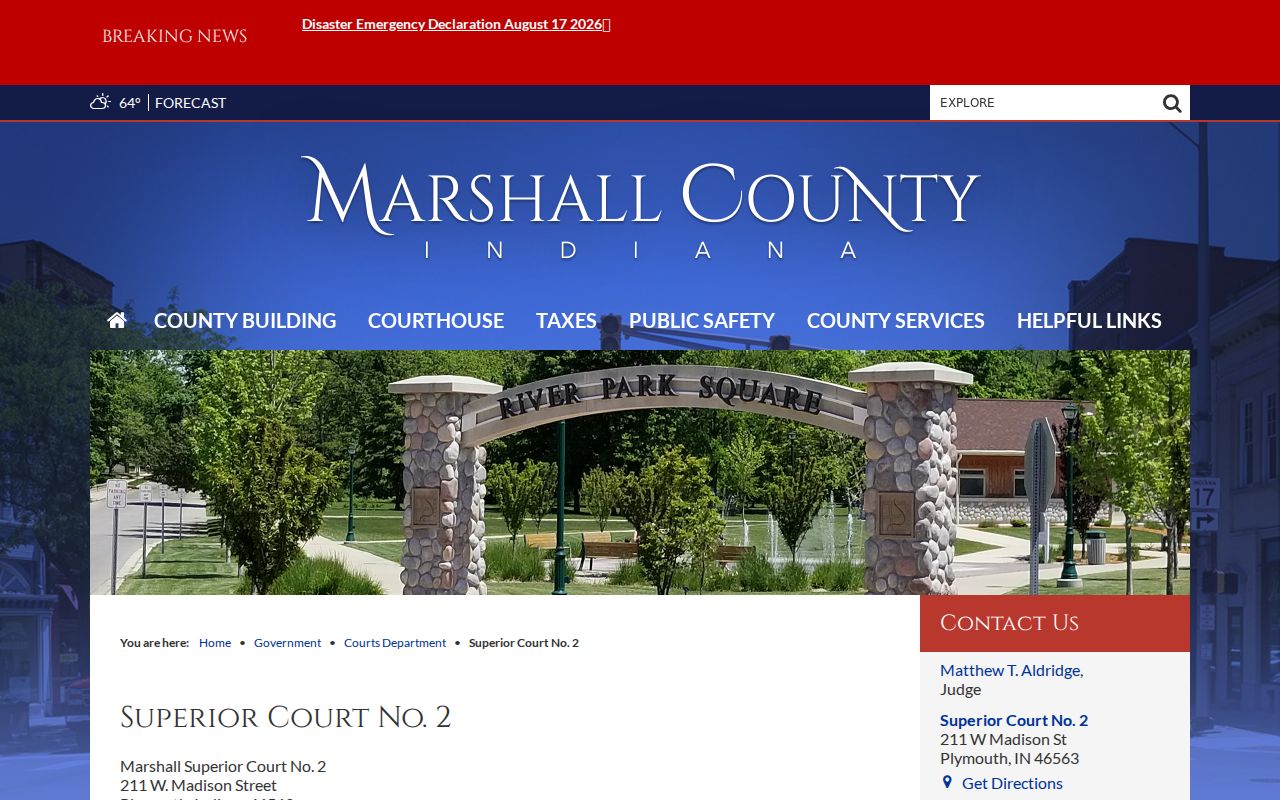
The court's own routing details provide the direct fallback when a public calendar result is missing, changed, or unclear.
Court Settings: What Each Field Means
A setting row is a planned event, not proof that it occurred. Match the court and cause number first. Then read the description, session, location, and officer. A row may carry a result, cancellation, or comment. MyCase supplies the later procedural trail.
| Date | The scheduled session date. |
|---|---|
| Time | Start, end, or timeslot; confirm whether it is a call or individual hearing. |
| Location | Location description and city when published. |
| Judge | The listed judicial officer, judge, or magistrate. |
| Setting Type | Status, pretrial, motion, plea, dissolution, guardianship, or trial. |
Marshall Setting Types Decoded
A status conference checks progress. A pretrial conference manages issues before trial. Neither label means the case has ended. A provisional-order hearing addresses temporary relief, while a final dissolution hearing can resolve a marriage case. Protection-order, guardianship, plea, dismissal, modification, and jury-trial settings have different purposes.
- Session
- The calendar block holding a hearing.
- Result
- The entered outcome, when published.
- Canceled reason
- The recorded reason a setting was removed.
- Judicial officer
- The judge or magistrate assigned to the event.
Read CCS entries filed after the scheduled date to learn whether it was held, continued, or replaced.
When a Court Date Moves
A reset or continuance changes the schedule. It does not dismiss the case. The old event may show a canceled reason, result, or comment, while a new CCS entry or notice gives the replacement date. Never infer the next setting from the usual weekday.
Use Reset before a new calendar query, confirm county and court, and check both dates when possible. If the online row conflicts with a signed order or notice, call the court that set the hearing. Only that court can settle the conflict.
Marshall CCS Date Cross-Checks
The CCS can show hearing date, session, location, officer, result, cancellation reason, comment, and a linked order. It is the chief cross-check for the short public calendar row. Run a Marshall County docket search by cause number and read entries after the first setting.
Older events need care. Circuit and Superior Courts 1 and 2 joined Odyssey in January 2017. Superior 3 joined in July 2021. Migrated entries may use a converted-event label with less detail. For a pre-Odyssey date or abolished court identifier, ask the clerk to locate the older record.
Missed Settings and What Comes Next
Act quickly after a missed Marshall setting. Check the CCS, call the assigned court, and notify counsel if represented. Do not assume payment or a portal search resolves the absence. The court may enter a new date, an order, a default, a failure-to-appear finding, or a warrant depending on the case.
Missed a setting? Failure to appear can cause a warrant, bond consequence, default, or other case-specific action.
Contact the assigned court or your attorney at once.
Get legal advice before appearing when a warrant may exist.
Superior Court 2 expressly routes missed-hearing and pending-warrant questions to menu option 2. Other courts use their own contacts. The clerk can identify an entry, but cannot give legal advice or promise a new setting.
Marshall Calendar Search Failures
A blank query may reflect the wrong date, a nonparticipating court, a broad case name, a moved event, or a date outside the range. Use the cause number. Clear the form before changing court or date, and never treat no result as a cancellation.
Restricted cases may not show enough detail. Sealed, juvenile, expunged, and confidential records do not appear like ordinary dockets. Contact Jenny Bennitt, Marshall County Clerk, at 211 W. Madison Street, Plymouth, Indiana 46563, 574-936-8922. Public hours are Monday through Friday, 8:00 a.m. to 4:00 p.m.
Marshall Hearing Location Checks
Marshall County uses more than one court address. Circuit Court is at 501 N. Center Street, Suite 301, while Superior Court 3 is at the same street address in Suite 100. Superior Court 1 is at 211 W. Madison Street, Suite 301, and Superior Court 2 is in Suite 201 at that address. The court name and suite matter. Do not choose a building from the case type alone because assignment and related-case rules can change the expected court.
Compare the location field with the latest notice before travel. A calendar row may give a location description and city, but the filed notice may carry the more exact room or remote-hearing instruction. Call the assigned court if the two differ. Arriving at the clerk's counter is not the same as appearing in the proper courtroom.
Virtual or live-stream information also requires a current court source. The statewide calendar links to current live hearing streams, yet that link does not mean every Marshall hearing is remote or publicly streamed. A party should use only the connection instructions issued for that setting. Public observers must follow the court's access and recording rules.